Privacy & Florida Glass in Siesta Key, FL
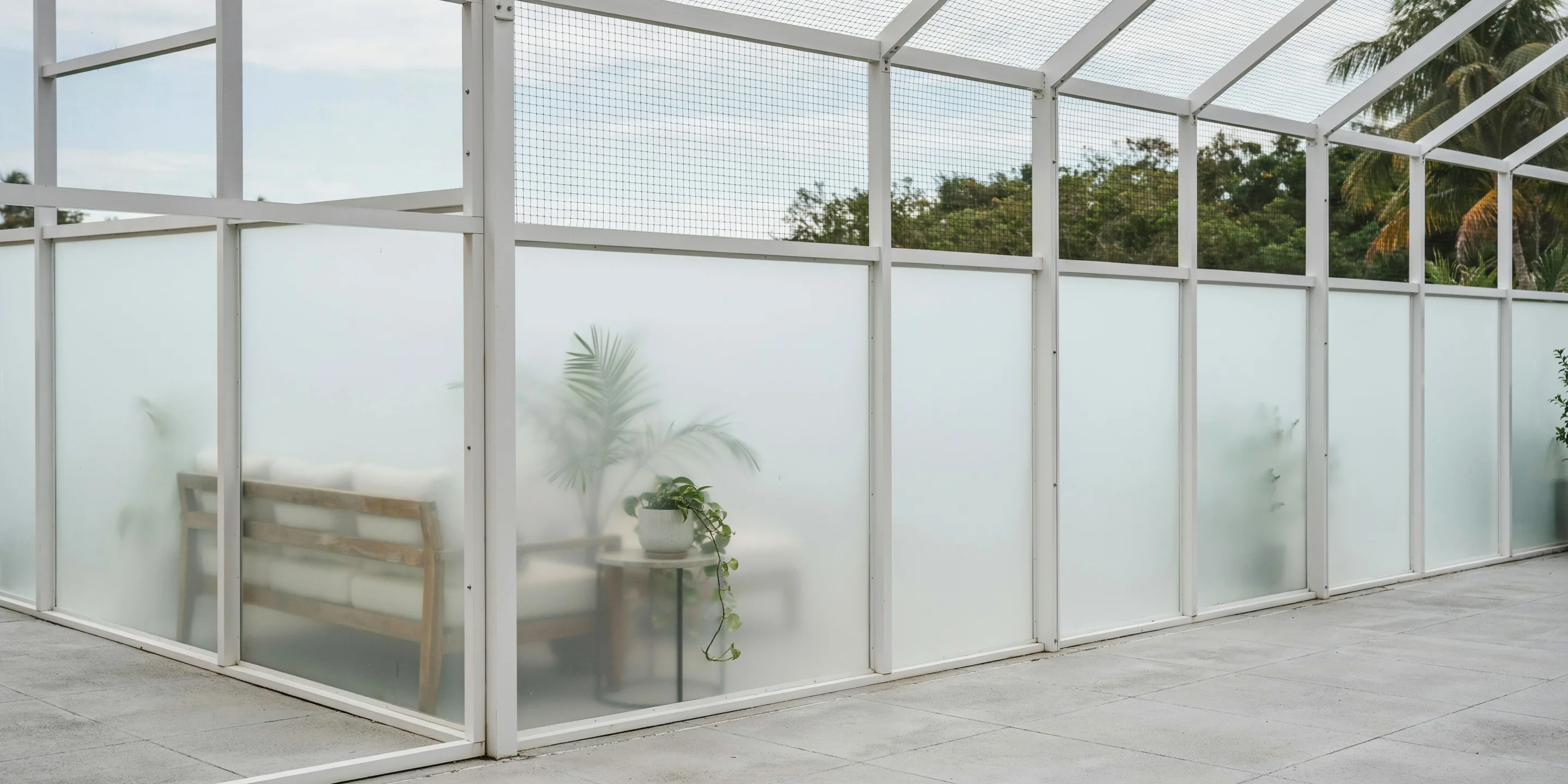
Island lots are close. A canal home on Siesta Isles or Country Club Shores can have a neighbor's pool deck a few yards from its own, and a zero-lot-line villa on Longboat may share a view with three others. Privacy screen and Florida glass solve that on the panels where it matters, without turning a screened lanai into a walled room.
Siesta Key Lanai Screens connects homeowners on the barrier islands with a local contractor who installs privacy mesh and Florida glass as part of everyday rescreen work. The contractor visits, looks at the sightlines and the wind, and writes up which panels earn the upgrade.
Two products, two jobs
Florida glass is not glass. It is standard fiberglass screen laminated with a vinyl backing, which makes it opaque and solid to wind and water while still going into the same screen channels as everything else. It reads as a soft, frosted panel. On lower walls it blocks blown sand and pool splash. On boundary walls it ends the sightline from the neighbor's yard entirely.
Privacy mesh is a denser weave that cuts what can be seen through it and softens the light without sealing the panel. Air still moves. It is the middle option for a wall where a full Florida glass panel would feel closed in.
Both are usually installed as a band or a wall rather than a whole cage. Florida glass on the lower panels with standard or no-see-um mesh above is the most common island configuration, since it keeps the breeze and the view at eye level.
Gulf-facing panels and turtle season
From May through October, light visible from the beach is regulated on Siesta and Lido under Sarasota County's marine turtle protection rules and on Longboat Key under the town's own ordinance, and that includes interior light carrying through a lanai screen. Florida glass or privacy mesh on Gulf-facing panels reduces what carries to the sand. It helps, and homeowners on the Gulf side often ask for it for that reason. It is not a substitute for compliant fixtures, and the contractor will say so rather than promise otherwise.
Associations and appearance rules
On Longboat Key and in the Gulf-front condominiums, lanai screens are commonly treated as limited common elements. The declaration decides who pays, and the association usually sets the approved mesh and color. Florida glass and privacy mesh come in shades that match standard charcoal screen, and contractors in this network are used to working inside an approved specification. Bring the declaration's answer to the estimate visit, or ask the contractor to help you frame the question for the board.
Cleaning and care
Florida glass shows salt film and pollen more than open mesh does because it is a solid surface. A rinse with fresh water and a soft brush keeps it clear. Privacy mesh cleans like any other screen. Neither needs anything special beyond what a salt-air cage already asks for.
As part of a larger project
Privacy panels install alongside a pool cage rescreen, a lanai or porch rescreen, or a no-see-um upgrade on the bay side, and they can be added to a cage whose other panels are sound. Because the frame is unchanged, the work generally does not require a permit in any of the four island jurisdictions.
Getting an estimate
Call (941) 555-0100 or send the estimate form. A local screen contractor will visit, look at the panels in question from both sides, and give you a written estimate in person.